Lebanon, Tennessee is the county seat of Wilson County, a rapidly growing community in Middle Tennessee positioned along Interstate 40 east of Nashville. As one of the region fastest-growing suburbs driven by Nashville expansion and the appeal of Wilson County schools, quality of life, and relative affordability compared to Davidson County Lebanon has seen significant residential construction activity that has placed thousands of new Asphalt Driveway Lebanon in service throughout the community. For Lebanon homeowners who have recently had a driveway installed or are planning to, understanding what a realistic lifespan looks like, what factors shorten or extend it, and what maintenance practices maximize the value of the investment provides a foundation for smart long-term property management.
The Expected Lifespan of an Asphalt Driveway in Lebanon
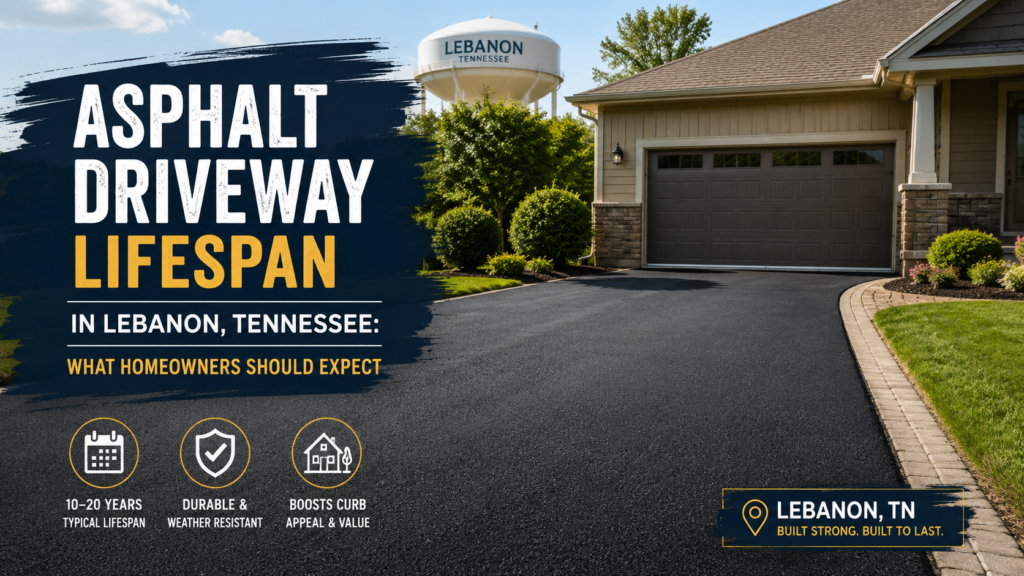
A properly installed and consistently maintained asphalt driveway in Lebanon, Tennessee should last 20 to 25 years before requiring full-depth replacement. Some driveways, under ideal conditions with exceptional maintenance, perform for 30 years or more. Others that were inadequately installed or received no maintenance may fail structurally within 10 years, requiring costly full replacement well ahead of schedule. Understanding what drives this range helps homeowners recognize which end of the spectrum their own driveway is likely to occupy.
What Determines How Long a Lebanon Driveway Lasts
Several factors, some controllable and some not, determine the service life of an asphalt driveway in Wilson County:
- Installation quality: This is the single most important determinant. A properly installed driveway requires adequate excavation to remove organic material, installation of a well-compacted aggregate base of appropriate depth (typically 4 to 6 inches of crushed stone), and a 2.5 to 3 inch compacted layer of quality hot mix asphalt applied at the correct temperature and compacted to the appropriate density. Driveways built with inadequate base depth or improperly compacted materials will develop structural failures within a few years regardless of surface maintenance.
- Climate and freeze-thaw cycling: Lebanon Tennessee climate classified as humid subtropical includes winters with periodic freezing temperatures, enough to produce meaningful freeze-thaw cycling. Wilson County averages 10 to 20 days per year below freezing. Water that infiltrates surface cracks freezes, expands, and widens those cracks with each cycle. Cumulative freeze-thaw damage over successive winters is a primary driver of premature asphalt failure in Lebanon.
- Tennessee clay soils: Wilson County soils include significant clay content in many areas. Clay swells when wet and shrinks when dry, creating seasonal sub-grade movement that transmits stress to the overlying pavement. Driveways installed over inadequately stabilized clay sub-grades develop cracking from movement below rather than from surface wear above.
- Annual rainfall: Lebanon receives approximately 50 inches of precipitation annually. Drainage design the grade and cross-slope that moves water off the driveway surface rather than allowing it to pond and infiltrate is essential to long service life. Driveways that hold standing water deteriorate significantly faster than those designed for positive drainage.
- Traffic loading: Standard residential passenger vehicle use produces much less stress on an asphalt driveway than occasional heavy vehicles loaded delivery trucks, concrete mixers, fire apparatus, or recreational vehicles. Driveways that regularly support heavy loads need additional base depth specified at installation; those that were designed for passenger vehicles only will deteriorate faster under unplanned heavy loading.
The Typical Deterioration Progression
Understanding the stages of asphalt aging helps Lebanon homeowners recognize where their driveway is in its lifecycle and what intervention is appropriate:
- Years 1-5 (Excellent condition): Fresh asphalt is dark black, flexible, and structurally sound. The binder retains its full flexibility. This is the period for initial sealcoating applied at 6 to 12 months post-installation and repeated every 2 to 3 years to protect against UV oxidation.
- Years 5-10 (Good condition with maintenance): UV oxidation begins to gray the surface. Minor surface cracking may appear. With regular sealcoating and prompt crack filling, the pavement maintains its structural integrity and service life proceeds on track.
- Years 10-15 (Fair condition): Without maintenance, the surface is noticeably gray with developing crack networks. With good maintenance history, the surface remains functional. This is a critical period addressing cracks before winter prevents base infiltration that accelerates structural failure.
- Years 15-20 (Deteriorating if not maintained): Alligator cracking patterns may appear if base damage has begun. Well-maintained driveways may still be candidates for overlay resurfacing, which adds 8 to 12 additional years at a fraction of replacement cost. Driveways with base failure require full replacement.
- Years 20-25 (End of design life): Most driveways that were properly installed and maintained are approaching the end of their service life. Full replacement becomes appropriate.
The Maintenance Program That Maximizes Lebanon Driveway Life
The difference between a 12-year driveway and a 25-year driveway in Lebanon Tennessee climate comes down primarily to maintenance consistency:
- Sealcoating every 2 to 3 years: This is the most impactful single maintenance practice. Sealcoating protects the asphalt binder from UV oxidation and maintains the dark black appearance that signals a healthy, well-cared-for surface.
- Annual pre-winter crack filling: Before Tennessee freeze season arrives ideally by late October any surface cracks wider than a hairline should be filled with rubberized asphalt sealant. This simple step prevents freeze-thaw damage from advancing minor surface cracks into structural base failures.
- Drainage management: Keeping driveway edges clear of vegetation that retains moisture, ensuring that downspout drainage is directed away from the driveway, and checking that the driveway cross-slope remains functional are low-effort practices with meaningful long-term impact.
Conclusion
An asphalt driveway in Lebanon, Tennessee can realistically serve a homeowner for 20 to 25 years when it is properly installed with adequate base preparation, maintained with regular sealcoating and annual pre-winter crack filling, and designed with drainage in mind. The Lebanon climate with its freeze-thaw cycling, significant rainfall, and clay-influenced soils creates real demands on pavement, but none of them are insurmountable with a consistent, proactive maintenance approach. Homeowners who understand the lifecycle of their driveway and intervene at the right time with the right treatment make the most of one of their property most-used and most-visible surfaces.